
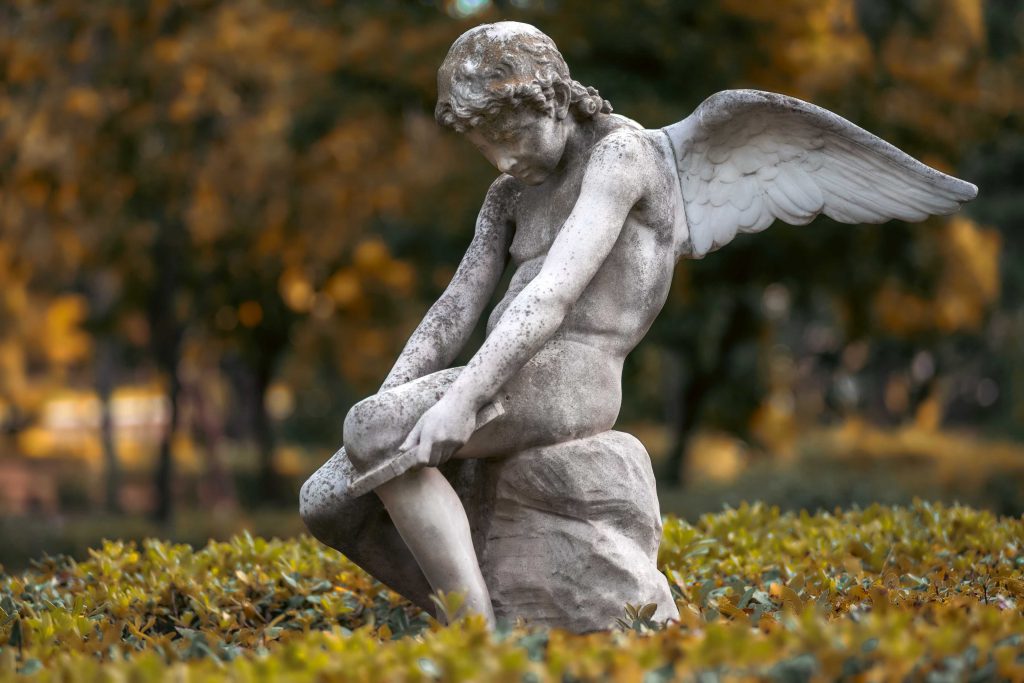
Toxothrafstis: Compound word meaning “bow” and “break”. The one who breaks his own bow. The god Eros has been depicted countless times in art in many different forms. There are different versions of his birth: son of Aphrodite and Mars or son of Aphrodite and Uranus or without parents as a result of Chaos and Gaia or Night and Erebus.
“I am magical and that is why you will never interpret me”
He stands alone in the flowery Zappeion. A winged fragment of love. Away from the other statues in the garden – which are admittedly numerous – Eros makes you wonder if he is alone by choice or if the other sculptures refuse his company. He doesn’t seem to care too much about his loneliness; he doesn’t care about passers-by and he is devoted to his work: to break his bow forever. A project that is doomed to remain unfinished. With stubbornness he destroys his own weapon; the weapon that was once responsible for the love between two people, since the legend says that the two people who were hit by Eros’ arrow fell in love instantly. According to Sophocles, love, Eros, is invincible. But here, do we see him in a moment of defeat? Has love been lost in modern times and is this the moment of his resignation from the earthly stuff? Is it the moment of absolute self-knowledge where he realizes the evil that he often causes and the troubles in which he puts his lovers? Is it just self-referential and reminds us of its often self-destructive dimension? Or, finally, it is a warning to the world: look what will happen if I break it and disappear! Either way, a lifelong picture of disaster can be for the better or for the worse. Depending on the angle from which you look at the sculpture!
Sculptor: George Vroutis (1843-1909)
Material: Μarble
Zappeion Megaron Garden
Vasilissis Olgas Avenue 1, Athens